
Skip to content
A practitioner working with a group of young learners around a table

Early childhood development & learner support · South Africa

Learning is decided before school, after school, and at home.

A classroom cannot repair what was missed in the years before it, in the four hours after it, or in the home around it. Early Rise builds centres that work in all three — mentored by an established private school brand, and priced for the families who need them.

What one centre carries

80

ECD learners

07:00–14:00, five days a week

400

Learner support members

After school, across 800 two-hour slots a week

Weekly

Parent seminars

Families taught how to support learning at home

8

Practitioners in training

Qualified staff, funded from the day it opens

01 The need

A child is failed in three places, and served in none of them.

Ask a working parent what they actually need and the answer is never one thing. It is somewhere good for the small one to spend the morning. It is somewhere the older one can go at two o'clock that is not the couch. It is knowing what to do at the kitchen table on a Tuesday night when the homework is not going in.

Each of those is a separate industry, and each one alone is too thin to sustain a good operator. So the good operators go where the money is, and the communities that need them most are served by whoever is left.

Early Rise puts all three in one building, with one team, on one lease — which is the only way we have found to make quality affordable to the families who need it, and viable for the people who deliver it.

Children and a practitioner holding a globe together in a classroom

A centre opens with twenty-four months of rent already funded, its furniture bought, its working capital in the bank and eight practitioners in training — which is why it can afford to be good before it is full.

01

The early years are not childcare

Everything a child does at school later stands on what was built before Grade 1 — language, attention, curiosity, the ability to stay with a problem that has not solved itself yet. There is no shortage of places to leave a child. There is a severe shortage of places where those years are actually taught, by a qualified practitioner, on a programme, at a ratio small enough for every child to be known by name.


02

The school day ends at two. The working day does not

Between two and six a learner is either being supported or being left. For most working families the honest choices are a childminder, an older sibling or a phone — and that is where the ground gained in the morning is quietly given back. It is also the cheapest gap in education to close, because a learner who gets help on the day they got stuck does not need remediation a year later.

03

Parents are the largest variable, and nobody trains them

A child spends far more waking hours with their family than with any teacher. Parents are expected to support learning at home, and are almost never shown how — not because they do not care, but because no one ever taught them the method. Trained parents are the single cheapest improvement available to any child, and the one nobody is selling.

02 The answer

One building. Eleven hours. Three programmes.

The morning, the afternoon and the home — covered by the same 240 m² and the same eight people, instead of three organisations that each need a building of their own.

A practitioner reading with a circle of pre-school children

Early Childhood Development

07:00 – 14:00, Monday to Friday

R2 500 a month

A full ECD programme delivered by qualified practitioners at a ratio of one to twenty. Executives receive and deliver for the first two hours of every day, so the morning opens with the most experienced people on the floor.

A practitioner supporting a learner at a desk

Aftercare & Learner Support

14:00 – 18:00, in two-hour slots

R200 a slot, minimum two a week

Peer-supported learner support, overseen by practitioners. Each practitioner holds twenty learners as ten peer twinships. Families buy slots, not a fixed timetable — and the more slots a learner takes, the further they get.

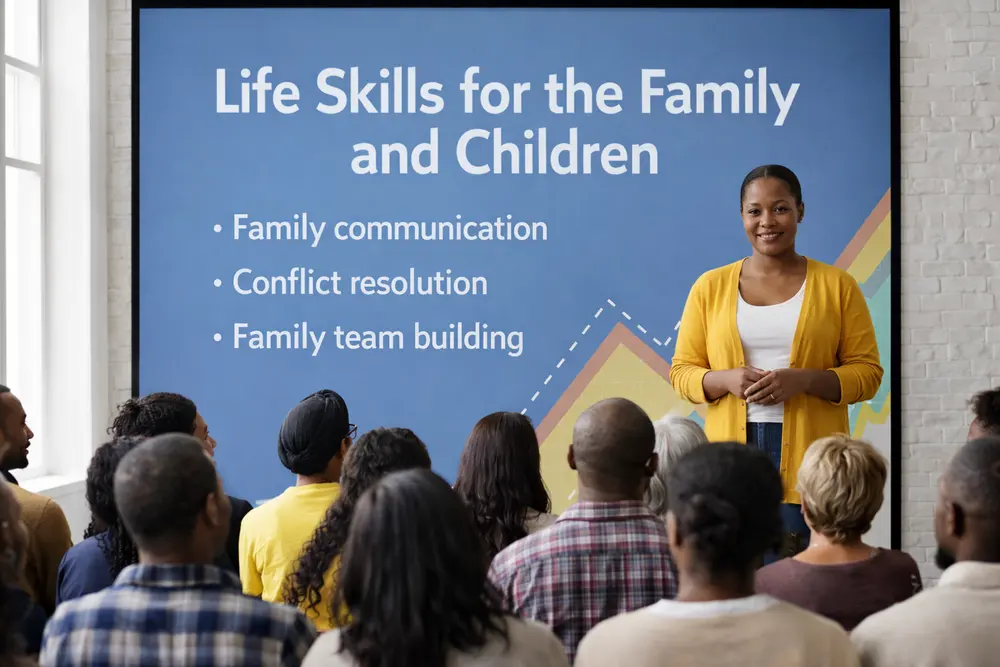
A facilitator presenting a family development seminar

Parent seminars

Weekly, held by the executive team

Included

Every week the executives train parents in learner support at home. It is how the programme reaches the hours nobody else can reach — and it is also the enrolment engine, because the room is full of the people who refer.

03 Why it will be good
A school principal in conversation with a family

Nobody should have to take a new centre's word for its quality.

So an Early Rise centre does not start from scratch. It is incubated inside the practice of an established private school. Our founding mentorship and incubation partner is Summerhill Nursery Prep & College in Midrand — a co-educational school running Nursery, Preparatory and College phases on one campus, founded in 1990, offering CAPS, Cambridge International and IEB.

Their Early Childhood Development phase provides the standards, the study methodology, the practitioner development and the honest opinion of people who have run an ECD phase for thirty years and cannot afford to have their name on something mediocre.

It is also the destination. A centre that performs extends upward into the phases above it, under the brand that mentored it.

04 The people

Nobody can staff a centre they did not train.

The sector's real constraint is not buildings, it is qualified practitioners. So every Early Rise centre opens with 8 learnerships already running, and every member of staff — executive and delivery alike — is a qualified ECD practitioner who can stand in front of children.

They are paid accordingly. Pay starts at R5 000 and rises with the centre's paid capacity, reaching R40 000 a month for a delivery practitioner when the centre is full. Good early childhood work is not volunteering, and a centre that cannot keep its people cannot keep its standard.

Learners at a professional training session A facilitator presenting a life skills seminar to parents
05 The business case

This is not charity. It is a business that pays for itself.

Two revenue lines, both paid monthly by the families who use them: R2 500 a month for the ECD programme, R200 a slot for learner support. Against that, a cost base you can hold in your head — eight staff and 240 m² at R180 the square metre plus VAT and R35 in utilities.

The centre covers its costs at 18% of capacity, and it gets there because it never stands idle: the same room and the same people carry a morning programme, an afternoon programme and an evening seminar.

Staff pay is geared to that. Nobody in this building gets paid well while the centre sits empty, and nobody stays underpaid once it fills — so the people delivering the quality are the people who gain from it.

Every figure on this site is computed from those assumptions, and published with them. You can change them yourself and watch the answer move.

Break-even
18% of capacity

15 ECD learners and 74 learner support members

Revenue at full capacity
R893k a month
Surplus at full capacity
R427k a month
Establishment cost
R2.54m once

Plus 8 learnerships

And a referral programme that pays parents in the only currency they want.

Every child a parent brings into the programme — outside their own family — earns that parent a 5% discount, for every month that child attends and pays. Twenty children, and their own child is carried free. It is the cheapest enrolment channel a centre will ever have, and it rewards exactly the behaviour that makes a centre worth talking about.

06 How it gets built

A centre that pays for itself still has to be opened by somebody.

The model works from the day the roll fills. It does not work on day one — no ECD centre does. Somebody has to carry the lease, the fit-out and the payroll through the two years it takes a community to trust a new centre, and the families who need it most are the last people who can pre-pay for that.

That gap is exactly the shape of a corporate enterprise and supplier development contribution. A funder must place ESD and skills development spend every year, and would rather it built something durable than disappeared into a report.

So the funder's spend establishes the centre, the school brand mentors it, and the community fills it — and pays for it, month after month, because what it buys is worth having.

Professionals in a working session around a boardroom table

The contribution is not a grant. The centre is a trading enterprise held under the holding company, and the funder takes equity in it — impact capital with an owner and a balance sheet.

01

The funder commits ESD spend

An enterprise and supplier development contribution establishes one Early Rise centre: twenty-four months of rent, the furniture, mentorship and incubation, working capital, and eight learnerships. The funder may nominate the location, and may attach a supplier development programme for the children of its own employees.

02

Early Rise establishes the centre

We site it, lease it, fit it, licence it and staff it with qualified ECD practitioners. The centre is held under the holding company, and the funder takes an equity share — this is impact capital with an owner, not a donation that disappears at year end.

03

A school brand mentors it

The centre is incubated inside the practice of an established private school. Summerhill Nursery Prep & College in Midrand is our founding mentorship and incubation partner: their Early Childhood Development phase sets the standard the centre is trained and measured against.

04

It trades, and it grows

ECD in the morning, learner support in the afternoon, parent seminars in the evening. As the roll builds and the cohort ages, the centre extends upward — foundation phase, then further — until it is a school carrying the partner brand.

Two children celebrating

The next centre

Tell us which community needs one, and we will build the case for it.

Send us a location, a budget envelope and your scorecard priorities. We will come back with a modelled centre — footprint, staffing, capacity, cash flow and the split between ESD and SD — as a written proposal.